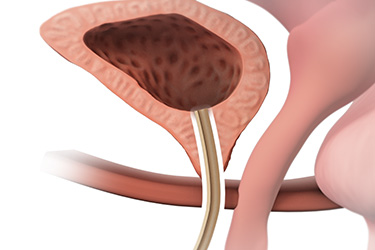
Watch this to understand what happens in the body when you have stress incontinence.
The urethra is the tube that allows urine to pass out of the body. Dysuria is the feeling of pain or burning in the urethra when you pass urine. Here's what you should know about caring for yourself at home.
Epididymitis is often caused by an infection. Treatment is with antibiotics, and anti-inflammatory and pain medicines. Read on for details on how to care for yourself or your child at home.
Blood in the urine has many possible causes. Read on to learn about why this occurs, as well as guidelines for home care and follow-up care.
Orchitis is inflammation of the testicles. Learn about this condition, including causes, risk factors, symptoms, diagnosis, treatment, and how to care for yourself at home.
Priapism is an erection that lasts more than 4 hours without sexual stimulation. Learn more about this condition.
Prostatitis is an inflammation of the prostate gland. This can occur with or without infection. Read on to learn how to care for yourself at home.
Narrowing or blockage of the urethra is known as a urethral stricture. This is more common in men than in women.
Urethritis is an inflammation in your urethra. The urethra is the tube that drains the urine out of your bladder. Urethritis is most often caused by a bacterial infection. Read on to learn more.
Urethritis is an inflammation in your urethra. It's most often caused by a bacterial infection. Here's how to care for yourself at home.
This condition causes pain or a burning feeling when peeing. In children, it may be caused by soaps or bubble baths. Read on to learn more.
Urethritis is an infection in the urethra. It's often caused by gonorrhea or chlamydia. This infection needs antibiotics. Learn more about home care.
A urine strainer is used to collect a kidney stone from the urine stream. Learn how to use a urine strainer.
Urinary retention means a difficulty or inability to pass urine, even with a full bladder. For girls and women, the most common cause of urinary retention is a bladder infection.
Urinary incontinence means not being able to control the release of urine from the bladder. There are many possible causes of urinary incontinence in men. Read on to learn more.
The most common place for a urinary tract infection is in the bladder. This is one of the most common infections in women. Most bladder infections are easily treated.
Learn about the causes, symptoms, care, and treatment of a bladder infection.
Learn how to care for yourself after being diagnosed with kidney stones.
Urinary incontinence means loss of bladder control. This problem affects many women, especially as they get older. Read on to learn about this problem and how it can be treated.
Sometimes, an abnormal passage forms from the anal canal to the skin near the anus. This is called an anal fistula.
A prostate abscess is a pocket of infection in the prostate gland. Learn about causes, symptoms, diagnosis, treatment, and possible complications.
Blood in your semen is called hematospermia. It may be stressful to see, but in many cases it's not a sign of a serious problem.
If you wake up often during the night with an urgent need to pee (urinate), you may have nocturia. This condition can affect anyone. But it is more likely to occur as you get older.
Follow the instructions on this sheet to learn how to remove a Foley catheter.
IC involves temporarily placing a tube (catheter) into the urethra. The urethra is the tube that carries urine out of the body. The catheter drains urine from the bladder. Once the bladder is empty, the catheter is removed. Learning how to properly care for your catheters helps keep them clean for you to use, which helps prevent infection.
Circumcision is a procedure to remove the foreskin, the loose fold of skin that covers the head of the penis. Read on to learn more about adult circumcision and how it's done.
A hydrocele occurs when fluid builds up in the layer of tissue that covers the testicle. This can cause pain or swelling in the scrotum. Hydrocelectomy is surgery to remove the hydrocele. Learn more about this condition.
Radical orchiectomy is surgery to remove a testicle. It's most often done to treat testicular cancer. Or it may be needed if a testicle is severely damaged due to infection or injury. Some forms of treatment for prostate cancer include orchiectomy. Learn more about this procedure.
Pyeloplasty is surgery to unblock the ureter and allow urine to flow again. Read on to learn more about the surgery and what to expect.
Ureteroplasty is surgery to remove a narrowing (stricture) in the ureter. Learn what to expect with this procedure.
Cancer has been found in the lower (distal) part of one of your ureters. To treat the cancer, distal ureterectomy is done. This surgery removes the lower part of the ureter and part of the bladder. Read on to learn more about this procedure and what to expect.
Pressure from a mass of tissue or scar tissue is blocking one or both of your ureters. This causes urine to back up into the kidneys instead of flowing out of the body. Ureterolysis can help treat this problem. With this surgery, the ureter is freed from the tissue that is pressing on it. The ureter is then moved to a new position away from the blockage. Read on to learn about this procedure.
With ureteral reimplantation surgery, 1 or both ureters are moved so their connection to the bladder is stronger. Read on to learn details about this surgery.
Total cystectomy is surgery to remove the bladder. It's most often done to treat bladder cancer. After the bladder is removed, a new bladder or a pouch is made to collect urine. This is called a continent urinary diversion. Learn more about this procedure.
Partial cystectomy is surgery to remove part of the bladder. It is most often done to treat bladder cancer. If the cancer is found at an early stage, this surgery may help cure it. After the surgery, the bladder will still function.
Urinary diversion is surgery that makes a new way for urine to pass out of the body. It may be needed if the bladder is diseased or damaged. It may also be done if another problem in the body keeps the bladder from working correctly. Learn how the surgery is done.
Ureterosigmoidostomy is surgery that creates a new way for urine to pass out of the body. This may be needed if the bladder has been removed due to problems such as bladder cancer.
Urethroplasty is surgery to treat a narrowing (stricture) of the urethra. It may be used if less invasive treatments don't work or aren't right for you.
Varicocelectomy is surgery to fix a varicocele. A varicocele is swelling of veins in the scrotum. This swelling is due to blood backing up in the veins.
Continent urinary diversion is surgery to make a new way for urine to pass out of the body. During the surgery, either a new bladder (neobladder) or a pouch is created. This is done using a piece of your own intestine (bowel). Learn about the details of this procedure.
Total cystectomy is surgery to remove the bladder. After the bladder is removed, the surgeon must make a new way to drain urine from your body. This is called urinary diversion. With incontinent urinary diversion, urine drains through a hole in your belly into a bag.
Vasectomy is a simple and safe surgical procedure that makes a man sterile. Because a vasectomy should be considered irreversible, it's a serious step to take.
If your child's testicle doesn't descend on its own, it should be treated to prevent future problems. Surgery is done to bring an undescended testicle into the normal position within the scrotum.
In many cases, epididymitis and orchitis occur along with urinary tract infections. Treatment includes medicine to get rid of the infection. It also includes medicine and other methods to ease symptoms.
Urethral implants (bulking agents) are one way to help treat incontinence due to a weak sphincter. Read on for details.
Incontinence may be treated with medicines or medical devices, by behavior changes, or with surgery.
Interstitial cystitis is a type of bladder problem. It makes the bladder wall sore and easily irritated. This can cause pain and other uncomfortable symptoms. Read on for some helpful lifestyle changes that may be part of your treatment.
Learn about the different types of treatment available to help manage interstitial cystitis.
Self-injection is a good choice if you have erectile dysfunction (ED). You put a tiny needle into the side of your penis and inject medicine. This helps your penis get hard and stay that way long enough for sex. And sex and orgasm will feel as good as always. You may be nervous about doing self-injection at first. But with practice, it will get easier. Your health care provider will show you how to do self-injection the first time. The simple steps are outlined on this sheet.
Penile self-injection is a simple technique that may improve your sex life. Some men even find that self-injection leads to an increase in natural erections. If you have questions or concerns about self-injection or erectile dysfunction (ED), talk to your healthcare provider. The information on this sheet will help you get the best results.
Peyronie disease occurs when the penis curves during an erection. Learn about treatment options.
TURP is a type of surgery used to treat a noncancer (benign) enlargement of the prostate, also known as BPH (benign prostatic hyperplasia). This surgical treatment removes prostate tissue to ease pressure on the urethra.
Take it easy for the first month or so while you heal. During the first few weeks, you may feel burning when you pass urine. You may also feel like you have to urinate often. These sensations will go away. If your urine becomes bright red, it means that the treated area is bleeding. This may happen on and off for a month or so after a TURP. If this occurs, rest and drink plenty of fluids until the bleeding stops.
The hospital stay after TURP surgery is often 1 to 7 days. Learn what to expect after the procedure.
A step-by-step look at how to get and keep an erection with a vacuum erection therapy system.
A varicocele is when the veins in your scrotum are enlarged. Your doctor may advise surgery or another procedure to close off the enlarged veins. Read on for more details about these treatments.
A vasectomy can sometimes be reversed, restoring the flow of sperm out of the body. Read on for details about the procedure.
The no-scalpel procedure is similar to a traditional vasectomy. But it's done without cuts (incisions) or stitches. And it generally results in faster healing. Read on for details.
A vasectomy is a safe procedure. But it does have risks. Read on to learn more.
Cystectomy is surgery to remove the urinary bladder. It may be done in certain cases of bladder cancer. Your healthcare provider can discuss the risks and benefits of the surgery with you.
Special erectile aids are sometimes used to treat erectile dysfunction. These are prescribed by a healthcare provider. Read on to learn about your options.
Surgery for erectile dysfunction isn't common, but it may be the best treatment in some cases.
A helpful, step-by-step guide to caring for an indwelling urinary catheter bag.
Epididymitis is often caused by bacteria in the urinary tract or by bacteria passed between partners during sex. It can also be a complication of certain hospital procedures, or it can be caused by use of a urinary catheter. Here's what you need to do at home to care for yourself.
During the laser prostatectomy, all or part of your prostate gland was removed. Here are some instructions to help you care for yourself once you are back home.
You had a procedure called radical prostatectomy. This removed the entire prostate and nearby tissues. This sheet will help you know what to do following surgery.
You had surgery to remove a bladder tumor. This procedure is called a transurethral resection of bladder tumor. Learn how to care for yourself at home after the surgery.
You are going home with a suprapubic catheter in place. This tube is placed directly into the bladder through your belly to drain urine from your bladder. You were shown how to care for your catheter in the hospital. This sheet will help remind you of those steps and guidelines when you are at home.
You have been discharged with an indwelling urinary catheter (also called a Foley catheter). A catheter is a thin, flexible tube. An indwelling urinary catheter has two parts. These instructions will help you care for your catheter and prevent infection.
You are going home with a urinary catheter and collection device (drainage bag) in place. You were shown how to care for your catheter in the hospital. This sheet will help you remember those steps when you are at home.
You are going home with a suprapubic catheter. This is a tube that drains urine from your bladder. You'll need to train your bladder to work as it did before. Read on to learn more.
Self-catheterization simply means putting a clean tube (catheter) into the bladder to empty urine. This helps you empty your bladder when it won't empty by itself or empty all the way. You were shown in the hospital how to do self-catheterization. The steps here should help you remember how to do it correctly.
Self-catheterization simply means inserting a clean tube (catheter) into the bladder to empty urine. This helps you empty your bladder when it won't empty by itself or won't empty all the way. You were shown in the hospital how to do this procedure. Read on for helpful step-by-step directions.
When the surgery is done, you'll go to the PACU (postanesthesia care unit). It is also called the recovery room. You'll stay in the PACU until you're fully awake. This is often a few hours. You'll then go to a regular room. Your hospital stay may last from 1 to 3 days.
Your recovery at home will take some time. You will likely need 6 to 8 weeks to recover fully. The guidelines below will help you heal.
To help treat stress urinary incontinence, your surgeon may do a procedure called retropubic suspension. This surgery is done through small incisions in the belly. During the surgery, sutures are used to firmly support the pelvic organs and help prevent urine leakage. Below are guidelines to help you get ready for surgery.
Read on to learn all about vasectomy, from getting ready, and surgery details, to recovering at home.
Urostomy is surgery that provides a new way for the body to get rid of urine (waste fluid). It's done when the bladder is diseased or damaged. During the surgery, the surgeon brings part of the urinary tract or some of the digestive tract through the abdominal wall. Learn about the different ways a urostomy can be done.
After a urostomy, urine drains into a disposable pouch. Here is information on different pouches and pouch accessories.
After a urostomy, you'll have to care for your stoma and the skin around it. Here is information for checking, cleaning, and protecting your stoma.
Taking good care of the skin around the stoma is very important to prevent skin problems after a urostomy. Learn about the most common skin problems and how to manage them.
You'll need to empty your pouch when it gets to be about one-third full. The pouch is likely to become this full every 2 to 3 hours. To empty your pouch, follow the steps below.
You'll be shown how to change your pouch before you leave the hospital. Plan to change your pouch every few days. And change it early in the morning, when your urine output is less. Read on to learn how to change your pouch.
A night drainage system collects and stores urine after a urostomy. That way, you can sleep all night without getting up to empty the pouch. Follow these step-by-step instructions.
You've just had a urostomy to provide a new way for pee to drain from your body. Follow the tips on this sheet to learn how to stay healthy and help prevent problems.
Varicocele embolization is a procedure to treat an enlarged vein in the scrotum. Varicoceles often form during puberty. Learn about how the procedure is done.
Varicocele embolization is a procedure to treat an enlarged vein in the scrotum. Your healthcare provider will block the flow of blood to the varicocele, and it will go away.
A sitz bath is a type of therapy done by sitting in warm, shallow water. Learn why and how a sitz bath is done.
An epididymectomy is a surgery to remove the epididymis. An epididymis is a tube that holds sperm. You may need this surgery if you have an infection, tumor, or cyst.
Hydrodistention is a procedure that fills up your bladder with water. It is used to help find out what may be causing your bladder pain.
Sacral nerve stimulation helps treat bladder problems caused by diseases of the nervous system. Before sacral nerve stimulation is done, you need a trial or test procedure to see if it will work. Read on to learn the details.
Step-by-step images showing how to insert a reusable urinary catheter if you are a man.
Images showing the steps to insert a disposable catheter if you are a man.
Learn how to care for yourself at home when you have benign prostatic hyperplasia (BPH).
When the kidneys don't work normally and waste products start to build up in the blood, this is called chronic kidney disease (CKD). Read on to learn how to care for yourself at home.
Learn how to care for someone who's had surgery to treat paraphimosis.
Urinary retention means having a hard time passing urine or not being able to, even with a full bladder. Read on to learn about causes, symptoms, treatment, and home care.
An artificial urinary sphincter (AUS) is a man-made device that works like your urethral sphincter. It's used to treat stress urinary incontinence.
A retrograde pyelogram is an imaging test that uses X-rays to look at your bladder, ureters, and kidneys. Read on for details about what to expect before, during, and after this test.
Apply self-care instructions for bladder training, and know when to seek care.